
The Southern Anthropological Society was founded in New Orleans on April 8, 1966, after 42 anthropologists then attending the Southern Sociological Society meetings gathered separately to draw up plans for an organization devoted solely to the study and development of anthropology in the U.S. South. The first President of the SAS was anthropologist Asael T. Hansen (University of Alabama).
In 2018, then-President Betty Duggan, focusing on anthropologist Charles Hudson’s Keynote Address at the 30th Anniversary of the SAS, summarized some of the challenges facing the Society in the early days:
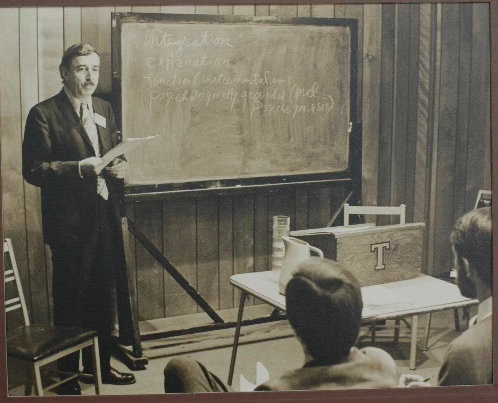
Hudson [University of Georgia] attributed the Society’s founding to John Honigmann’s (UNC) 1965 action at the New Orleans meeting. Following up on general discussions that year among colleagues, Honigmann sent out postcards inviting the handful of anthropologists who were members of the Southern Sociological Society to meet together to form a separate organization at the next SAS conference. As Hudson put it, “there was no way to go but up” for Southern anthropology and anthropologists in the South in the 1960s. He estimated at that time: there were about 0.46 anthropologists per million people in the South, versus 3.2 in the Northeast and over 4.0 in the Southwest; further, no deceased anthropologists known for studying the South, or even based in the South, had garnered so much as a half page in histories of anthropology; and, too many Ph.D. graduates answered the exit university interview question about which region they wanted to teach in as “anywhere but the South.”
This organization, both in and of the U.S. South, would focus not only on developing greater awareness of the work of practicing anthropologists employed in the U.S. South in all four subfields (cultural anthropology, archaeology, biological anthropology, and linguistics) and conducting research all over the world in highly diverse field settings, but it would also serve to focus – in part – on research conducted in the geographical region of the U.S South.
By April 1, 1967, at the second meeting of the Southern Anthropological Society in Atlanta, GA, there were 87 registered anthropologists in attendance, and the newly drawn-up Constitution of the SAS noted that its mission is, “the promotion of anthropology in the southern United States.
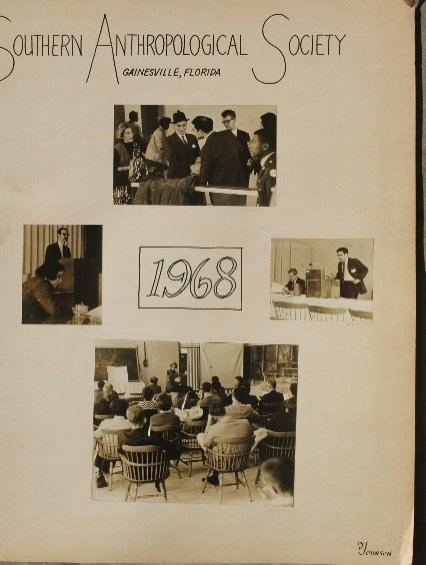
Continuing from Duggan’s 2018 Program Notes:
“In 1968, there were 88 members, drawn from several Southern states. By 1970, SAS’s membership mushroomed to 361, with members hailing from 35 states and several foreign countries. Ambitious from the start, the fledgling SAS looked to the American Ethnological Society (AES) as a role model for organizational framework and rules. Officers set about developing a newsletter, constitution, an annual invited Keynote Symposium, publication series from those symposia, and encouragement of graduate student presentations alongside those of professional members.
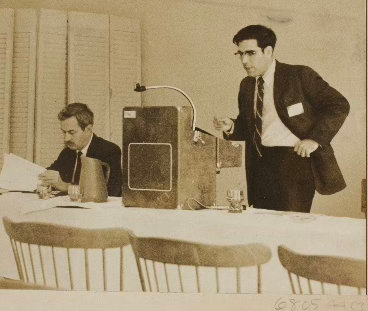
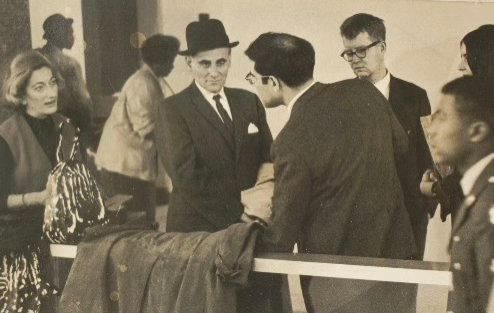
The Keynote Symposia and linked Proceedings publication series were critical elements in the founders’ plans, with their joint purposes to raise the profile and standing of anthropology about the South within the broader profession, and in critical theoretical discourse. Accordingly, the Keynote symposia and Proceedings for the 1967 and 1968 meetings, held jointly with SSS [Southern Sociological Society] and AES [American Ethnological Society], respectively, focused on Medical and Urban anthropology in the South, then both emerging areas of study. The 1969 Key Symposium and Proceedings drew participation from leading American anthropologists in anthropological and symbolic theory, including Eric Wolfe, Victor Turner, Mary Douglas, David Schneider, and the young James Peacock (UNC; later SAS President, 1985-1986). For nearly 40 years, the University of Georgia Press would publish SAS Proceedings, with Mary Helm (UNCG) and Chris Toumey (USC) as two long-term editors. Many of the volumes and/or articles in them remain classics in Southern anthropological studies, including Hudson’s own 1971 volume (from the 1970 Keynote Symposium), Red, White, and Black: Symposium on Indians in the Old South, which is still the series’ best seller. […].”
Duggan, Betty. 2018. SAS Program Notes.
Southern Anthropological Society. 2005. Culture, Ethnicity, and Justice in the South: The Southern Anthropological Society, 1968-1971. Tuscaloosa: Univ of Alabama Press, p. 2. Introduction by Miles Richardson.